
How to Become a Dietitian in India: Step-by-Step Guide to Courses and Career Path
Every results season, the same student walks into my cabin. Strong in biology, genuinely interested in food and health, and applying for MBBS only because someone at home said so. Then they learn that India carries one of the largest diabetic populations in the world, that urban obesity has climbed sharply in a decade, and that hospitals, gyms, food companies and even genetic testing labs are hiring nutrition professionals. Dietetics stops looking like a backup plan.
If you are trying to figure out how to become a dietitian in India, this guide covers the full route. Subjects you need in class 11 and 12, which degree to pick, whether an internship is compulsory, what RD registration actually involves, what you can realistically earn, and where the newer field of personalised nutrition fits in.
Who is a dietitian and how is it different from a nutritionist
Most people use the two words interchangeably. The industry does not.
A dietitian is a clinically trained professional qualified to plan therapeutic diets for people who are unwell. Renal diets for dialysis patients, tube feed calculations in an ICU, low sodium plans after cardiac surgery. That clinical credibility comes from a recognised degree in food and nutrition or dietetics, a hospital internship, and registration with the Indian Dietetic Association as a Registered Dietitian.
A nutritionist works on the wellness side. Weight management, sports performance, general healthy eating, community nutrition. The title is not legally protected in India, which is why the market is crowded with people who finished a six week online certificate and printed visiting cards.
Here is the part most students get wrong. Every registered dietitian can practise as a nutritionist. Not every nutritionist can practise as a dietitian. If you want to work inside a hospital, the RD route is the one that matters.
Eligibility: what you need in class 11 and 12
The decision starts earlier than most families realise. You need science in class 11 and 12, ideally Physics, Chemistry and Biology. Biology opens the widest set of doors, because almost every BSc in nutrition and dietetics lists it as compulsory or strongly preferred. Students with PCM are not shut out either. Several universities, including specialised institutes offering nutrigenetics programmes, accept Mathematics in place of Biology, and Home Science with Biology is accepted at Delhi University and many state universities.
On marks, most colleges ask for 50 percent aggregate in class 12, with about 5 percent relaxation for reserved categories. Government college cutoffs run far higher in practice. There is no upper age limit, so career changers in their late twenties and thirties do enter this field.
How to become a dietitian in India: the step by step path
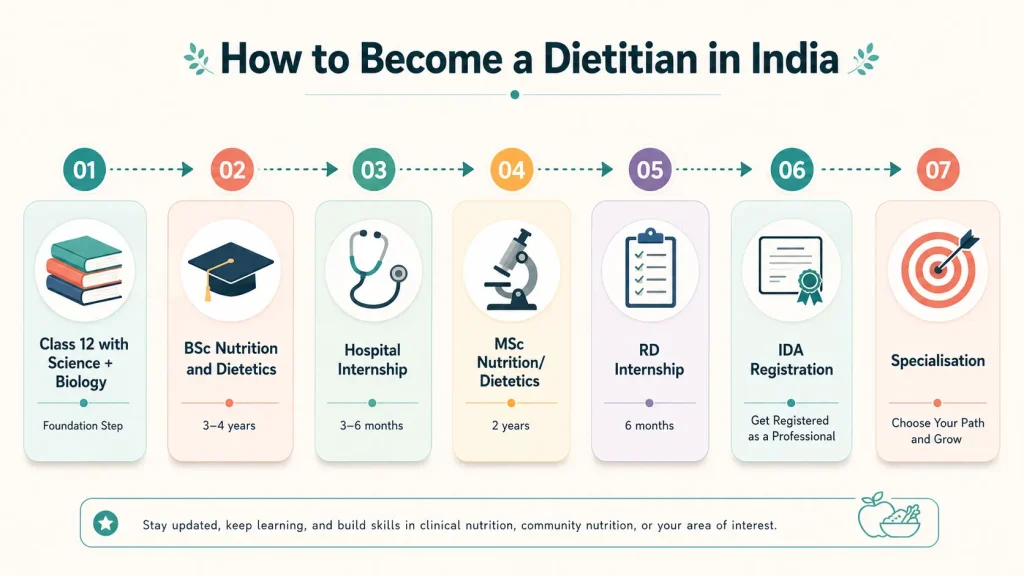
Step 1: Clear class 12 with the right subjects
Take science with Biology if you can, and keep your board percentage healthy, because at many good colleges it is still the primary selection filter. Already in class 12 with commerce or arts? You can still move into nutrition later through a postgraduate diploma, though the clinical dietetics door will be narrower.
Step 2: Pick your bachelor degree
This is where the real choice happens. The common options in India are:
- BSc in Nutrition and Dietetics or BSc in Food and Nutrition, the classic three year route and the safest choice for hospital work
- BSc in Home Science with a Food and Nutrition specialisation, offered widely by state universities
- BSc in Food Science and Technology, which leans towards the food industry and product development rather than patients
- BSc in Clinical Nutrition, run by several private universities and health science institutes
- BSc in Nutrigenetics and Personalised Nutrition, a newer four year specialisation combining dietetics with genetics and molecular nutrition
If you are sure about hospitals, a BSc in Nutrition and Dietetics is the most direct path. If you want to be positioned for where the field is heading, a genetics linked programme deserves a serious look. Compare the structure of these newer programmes on the courses page before you shortlist.
Step 3: Understand the admission process
Good news for anyone dreading another competitive exam. NEET is not required for a BSc in nutrition or dietetics, and that single fact changes the plan for a lot of families.
Admission works in three ways. Central universities such as Delhi University admit through CUET UG. State universities often admit on class 12 merit alone. Private universities and specialised institutes run their own process, usually an online form, document verification and a short interaction. Admissions for the 2026 to 2027 session are already open at several institutes, so track the admission page of any college you are serious about.
Step 4: Complete your internship or clinical training
This step separates a degree holder from a practising dietitian. Most BSc programmes include a supervised internship in the final year, usually three to six months in a hospital dietetics department, rotating through diet counselling, therapeutic diet planning and case presentations.
Take it seriously even though it pays little or nothing. This is where you learn to handle a patient who has just been told to stop eating rice and is quietly furious about it. It is also the most common source of first job offers.
Step 5: Do a master degree
Technically optional, practically close to essential. An MSc adds two years, but it is what large hospitals, research organisations and corporate wellness employers look for, and it sits on the standard RD eligibility route.
Options include MSc in Food and Nutrition, MSc in Dietetics and Applied Nutrition, MSc in Clinical Nutrition, and MSc in Nutrigenetics and Personalised Nutrition. The last is the newer research backed specialisation, built around how genetic variation changes a person response to diet. Eligibility is generally a graduation in life sciences or an allied health science subject, with a two year duration.
Step 6: Register as a Registered Dietitian
In India the recognised credential is the RD awarded through the Indian Dietetic Association. The usual route is a postgraduate degree in food and nutrition or dietetics plus a six month internship in a recognised hospital, followed by the IDA registration examination. Registration is renewed periodically and requires continuing education credits.
The RD tag is not a formality. In corporate hospitals it decides whether your file is shortlisted at all, and in private practice it is the fastest way to build patient trust.
Step 7: Build experience and choose a specialisation
The first two years after qualifying are for exposure. Handle diverse cases, learn to write clean diet charts, and counsel real people with real budgets and real family kitchens. After that, specialise. Renal, paediatric, oncology, sports nutrition, diabetes education or nutrigenetics. Generalists earn steadily. Specialists earn well.
Types of institutes worth shortlisting
Rather than chasing a ranking list, look at three categories and match them to your goal.
Government and long established university departments give the best value for money. Lady Irwin College and the Institute of Home Economics under Delhi University, SNDT Women University and Nirmala Niketan in Mumbai, and Avinashilingam University in Coimbatore carry decades of credibility, with fees generally from 15,000 to 60,000 rupees a year. Seats are few and cutoffs are steep. Hospital linked programmes at AIIMS Delhi, PGIMER Chandigarh and CMC Vellore are the strongest route for clinical work because internship exposure is built in. Private universities such as Manipal, Amity, Chandigarh University and Rayat Bahra offer better infrastructure and placement support at roughly 80,000 to 2,00,000 rupees a year.
The third category is specialised institutes. The Institute of Nutrigenetics and Nutrigenomics Research, set up in 2022, runs BSc, MSc, PG Diploma and certificate programmes focused entirely on nutrigenetics and personalised nutrition. Its degree programmes are offered in academic association with Rayat Bahra University, Mohali, where India first dedicated Department of Nutrigenetics was established in 2023, with the Institute of Translational Health Science (ITHS) acting as research and training partner. For a student, that structure matters more than it sounds. The degree carries university recognition, while the laboratory work and clinical exposure come through the specialised institutes.
Career paths after you qualify

Dietetics is one of the few health science fields where you can genuinely choose between a salaried role, a research career and your own practice.
- Clinical dietitian in a hospital, working with physicians on inpatient and outpatient nutrition therapy
- Sports nutritionist with academies, franchise teams, fitness chains or individual athletes
- Corporate wellness consultant running health programmes for IT parks, factories and large offices
- Nutrigenetics counsellor, converting DNA based test reports into practical eating plans
- Research associate at ICMR National Institute of Nutrition, university labs or nutraceutical companies
- Food industry roles in product development, FSSAI labelling compliance and quality assurance
- Private practice, online consultation and clinic ownership
Dietitian salary in India: what to realistically expect
Treat the numbers on career websites with caution. Real pay depends on city, employer type and whether you hold an RD credential. A fresher clinical dietitian in a mid sized private hospital typically earns 18,000 to 30,000 rupees per month, with metro corporate chains at the higher end. Food industry and corporate wellness roles generally start a little higher, around 3.5 to 5 lakh rupees per year. With three to six years of experience, most dietitians in good hospitals or wellness companies earn between 5 and 9 lakh per year, and department heads in large corporate hospitals usually sit in the 9 to 15 lakh range. Sports nutritionists with professional teams and experienced nutrigenetics consultants can go higher, because trained people are scarce.
Private practice has the widest spread. Consultation fees commonly run from 500 to 3,000 rupees per session depending on city and reputation. A dietitian with a steady patient base and online consultations can outearn most salaried peers, though it usually takes three to four years of visible work to get there.
Why nutrigenetics is becoming a valuable specialisation
For decades, diet advice worked on averages. One diabetic chart, adjusted a little for weight and activity. Anyone who has counselled patients knows how often that fails. Two people follow the same plan and get completely different results.
Nutrigenetics explains a large part of that gap. It studies how variations in individual genes change the way a person metabolises fat, carbohydrate, caffeine, folate and vitamin D, so a patient with a particular variant may need a very different fat profile than the standard chart suggests. Genetic testing is now affordable enough that Indian labs, wellness chains and preventive health companies offer these panels routinely. What is missing is trained professionals who can read those reports and turn them into a diet a family can actually cook.
That is the gap institutes like INNR are built to fill, with programmes sitting at the intersection of dietetics, genetics and molecular nutrition. If that direction interests you, the courses page lists eligibility and duration for each programme.
Frequently asked questions
Can I become a dietitian without NEET?
Yes. NEET is not required for a BSc in nutrition and dietetics or in nutrigenetics. Admission runs on class 12 marks, CUET UG for central universities, or the institute own application process.
How many years does it take to become a dietitian in India?
A bachelor degree takes three years, or four for programmes such as BSc Nutrigenetics. A master degree adds two years and the RD internship six months. Most people are fully qualified and registered within five to six years of class 12.
Is dietitian a good career in India?
It is a stable and growing one. Rising diabetes, obesity, PCOS and cardiac disease have pushed demand up across hospitals, corporate wellness and preventive health. Early growth is steady rather than dramatic, and income rises sharply once you specialise or build a practice.
What is the salary of a fresher dietitian?
Typically 18,000 to 30,000 rupees per month in a hospital, and roughly 3.5 to 5 lakh per year in food industry or corporate wellness roles. Metro cities and RD qualified candidates command the higher end.
Can I become a dietitian after a BSc in a different subject?
Often yes. Many MSc, PG Diploma and certificate programmes accept graduates from life sciences and allied health science backgrounds, which lets students from biotechnology, microbiology and zoology move into this field.
Final thoughts
Working out how to become a dietitian in India comes down to a few clear decisions. Science with biology in class 12, a solid bachelor degree, an internship you take seriously, a master degree, and RD registration. After that, the specialisation you pick decides how far the career goes. If you want to work beyond standard diet charts and into personalised, genetics informed nutrition, look at the specialised BSc, MSc and diploma programmes offered at Institute of Nutrigenetics and Nutrigenomics Research (INNR) through nutrigenetics.in. It is a narrower path, and for the right student, a far more interesting one.